Publishing27 May 20263 min read
What it costs to publish a book in India, and why
Publishing quotes vary by a factor of ten for what looks like the same service. Here is what is actually inside the number.
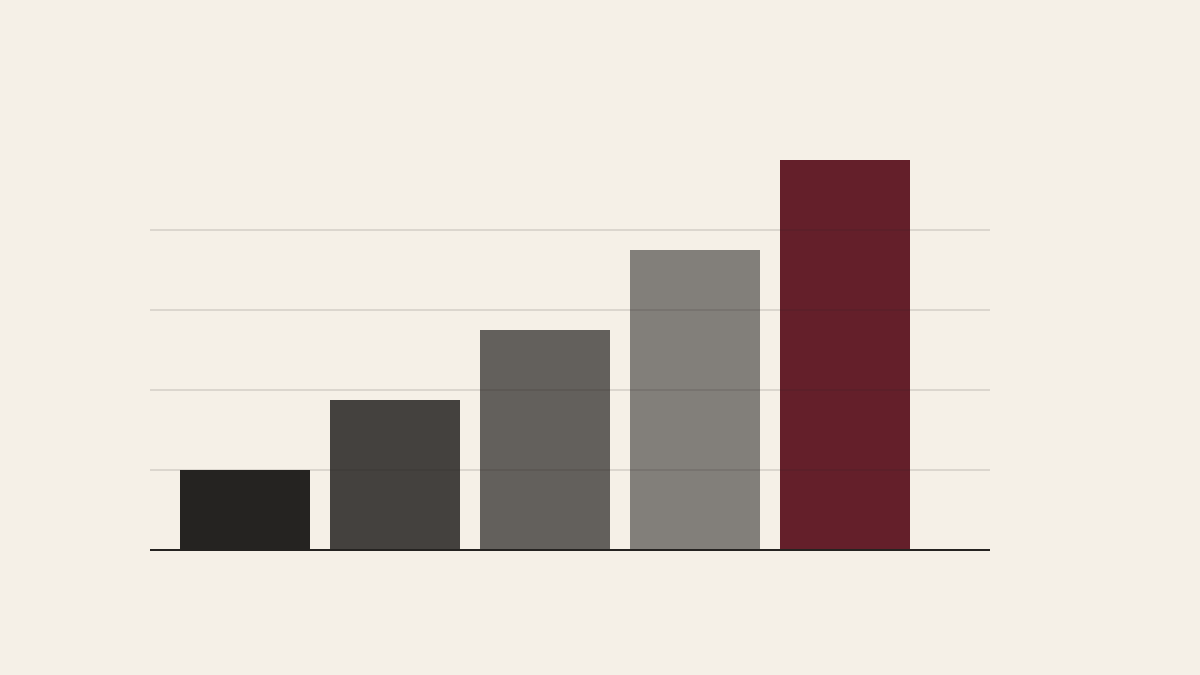
Ask three publishers what it costs to publish a book and you will get three numbers that do not resemble each other. This is not because one of them is lying. It is because "publishing a book" describes anything from uploading a PDF to a print-on-demand platform to producing a cloth-bound illustrated edition with a proper editorial process behind it.
The useful question is not "how much does it cost". It is "what is inside this quote".
The things that actually move the price
Manuscript length. Editorial work is quoted per word, and so is typesetting to a degree. A 40,000-word book and a 140,000-word book are not the same project.
Editorial depth. A proofread is a fraction of the cost of a developmental edit. If a quote does not say which editorial stages are included, assume the cheapest one.
Design complexity. A text-only novel interior is a solved problem. A book with 118 photographs, a two-level index, tables, or an illustrator to commission and art-direct is a different order of work.
Format and finish. Paperback or hardback; matt or gloss; jacket or printed board; standard stock or a specific paper; foil, deboss, spot varnish. Each of these is a real cost, not an upsell.
Print quantity and method. Print-on-demand has no setup cost and a high per-copy cost. Offset has a real setup cost and a low per-copy cost, and it becomes the cheaper option somewhere between 300 and 1,000 copies depending on the book. Below that threshold, offset is usually the wrong answer regardless of who is selling it.
The things that should not be a line item
Some charges appear on publishing quotes that deserve scrutiny. A "marketing package" with no defined deliverables. A "bestseller campaign". A per-title fee for an ISBN that was obtained free. A distribution charge for listings that anyone can create.
None of these are inherently fraudulent. All of them should come with a written description of what you receive and what happens if it does not work.
What a quote should contain
Before you pay anything, you should be able to read a document that states:
- which editorial stages are included, and at what depth
- how many rounds of author review you get, and what happens after those
- what design work is included and how many cover routes you will see
- the exact format, extent, paper and finish
- the print quantity and method, and the cost per additional copy
- who registers the ISBN and who is named as publisher on it
- which distribution channels are being set up
- what you own at the end of it, and for how long
If a quote does not say these things, the gap is not an oversight. It is where the disagreements will happen later.
On guarantees
No publisher, of any size, in any country, can guarantee sales. Anyone who does is either promising to buy copies themselves or hoping you will not check. Traditional publishers with marketing departments and bookshop relationships cannot promise this. Nobody smaller can either.
What can be guaranteed is the work: that the manuscript was properly edited, that the cover belongs to the book, that the interior is typeset by someone who understands what a widow is, and that the metadata is correct so the book can be found by people looking for it.
That is a narrower promise. It is also the only honest one.