Publishing15 August 20263 min read
The book is not finished when the manuscript is
A manuscript can be finished and the book can still be wrong. Good publishing connects the words, the object and the reader.
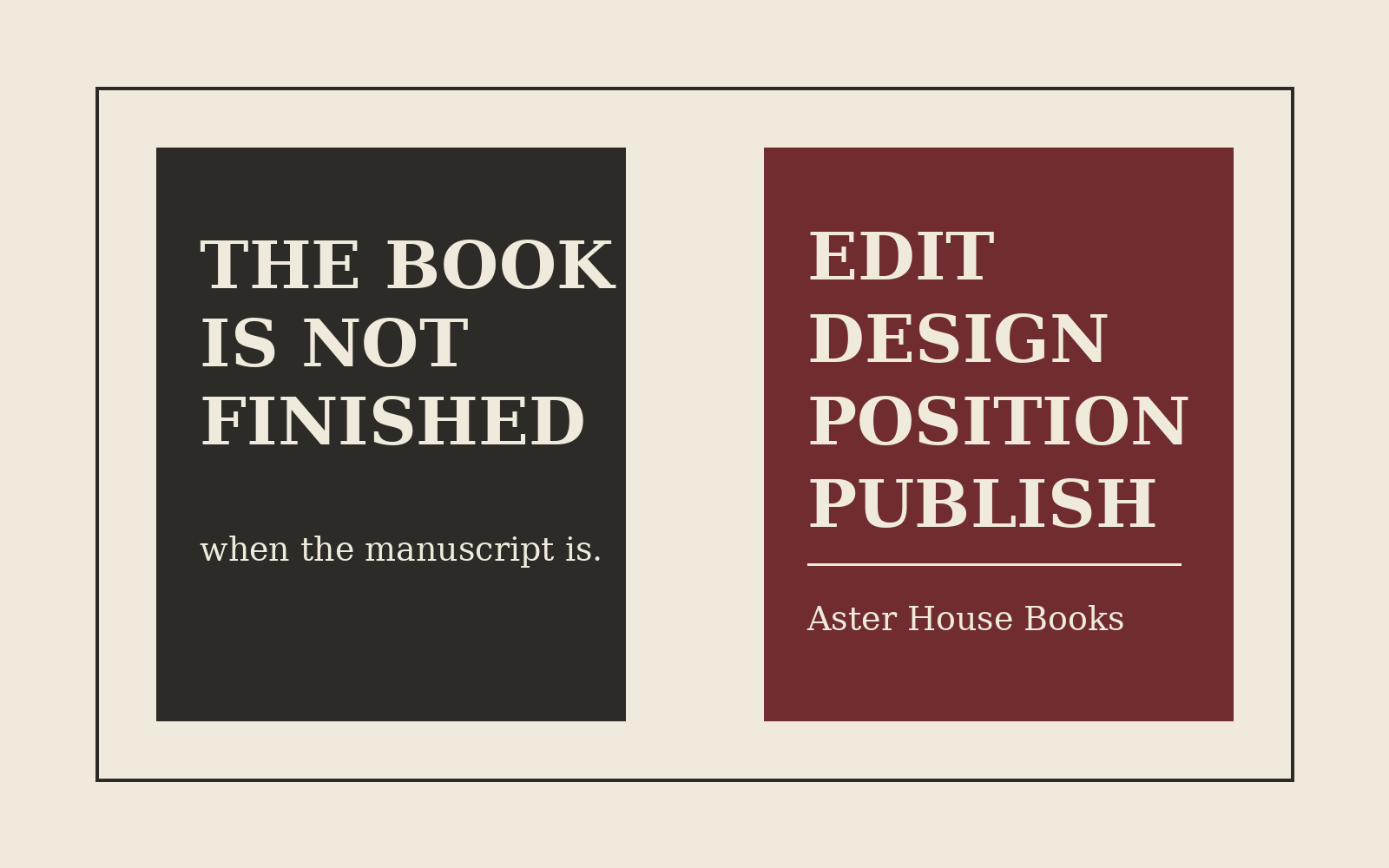
A good book is edited twice: once for the reader, and once for the shelf.
The manuscript may be finished. The book isn't.
A publisher's job is partly to ask whether the sentences work, but also whether the object, the metadata, the positioning and the route to the reader are working together. A beautiful manuscript can still arrive looking like it has wandered into the wrong shop.
The manuscript
Editing is not a hunt for commas.
The useful questions are bigger: Is the opening doing its job? Does the argument arrive when it should? Is the middle carrying its weight? Does the ending feel earned? Are there three chapters saying the same thing in slightly different hats?
Line editing comes later. Copy-editing comes later still.
The point is not to make the manuscript sound like an editor wrote it. The point is to make it sound more like the author meant it to.
The proposition
Every book needs a reason for existing in a reader's life.
That does not mean reducing it to a slogan. It means being able to answer a slightly awkward question: why this book, and why now?
For fiction, that might be voice, premise, emotional promise or the particular pleasure of the world being built. For nonfiction, it might be authority, usefulness, a new argument or simply a much better way of explaining something readers already care about.
If we cannot explain the book without saying "it's for everyone", we have not finished thinking about it.
The package
Title, subtitle, cover, typography, format and back-cover copy are not separate jobs.
They are one conversation.
The cover establishes the category. The title makes the promise. The subtitle, where there is one, narrows it. The back cover gives the reader a reason to believe the promise. The physical book then has to make good on it.
This is why changing a title late can have surprisingly large consequences. It is not one line on a title page. It can change the cover, the metadata, the sales copy, the catalogue entry and how the book is understood at a glance.
The shelf
Books are rarely encountered in isolation.
They sit beside other books in a shop, in a search result, in a social post, in a recommendation email, or on a reader's nightstand. The question is not simply "is this attractive?" It is "does this look like the right book to the right person?"
That means looking at the competitive set before making decisions.
Not copying it. Not following a trend because everyone else has. Understanding the visual and commercial language the reader already recognises, and then deciding where this book belongs within it.
The launch
A launch is not a single day.
It is the accumulation of small reasons to notice a book: an author introduction, an extract, a useful idea, a review, a conversation, a good retailer description, a person recommending it to another person.
The work starts before publication and continues afterwards.
And yes, sometimes the most useful launch plan is considerably less glamorous than anyone hoped. A very good email to the right fifty people can beat a very expensive idea aimed at everyone.
What we ask before we publish
- Who is the reader, specifically?
- What does this book do better or differently?
- What will make someone stop scrolling?
- What should they understand before they read a page?
- What should they feel when they hold the finished book?
- Where are they most likely to discover it?
- What needs to be true for the book to keep finding readers after launch?
The answers shape the editorial, design, metadata, production and marketing decisions.
And one thing we do not do
We do not treat publishing as a sequence of departments passing a manuscript down a corridor.
A book is a single thing.
The editing affects the design. The design affects the positioning. The positioning affects the copy. The copy affects discovery. Discovery affects sales. And sales, inconveniently, tell us whether the whole thing worked.
That is the job: not merely getting a manuscript into print, but making a book that has a fighting chance of being found, understood and remembered.