Editing4 November 20265 min read
Your draft needs help, but which kind?
Editing isn't one job. Here are the five kinds, what each one fixes, and the order your draft should meet them, with one very badly behaved dragon.
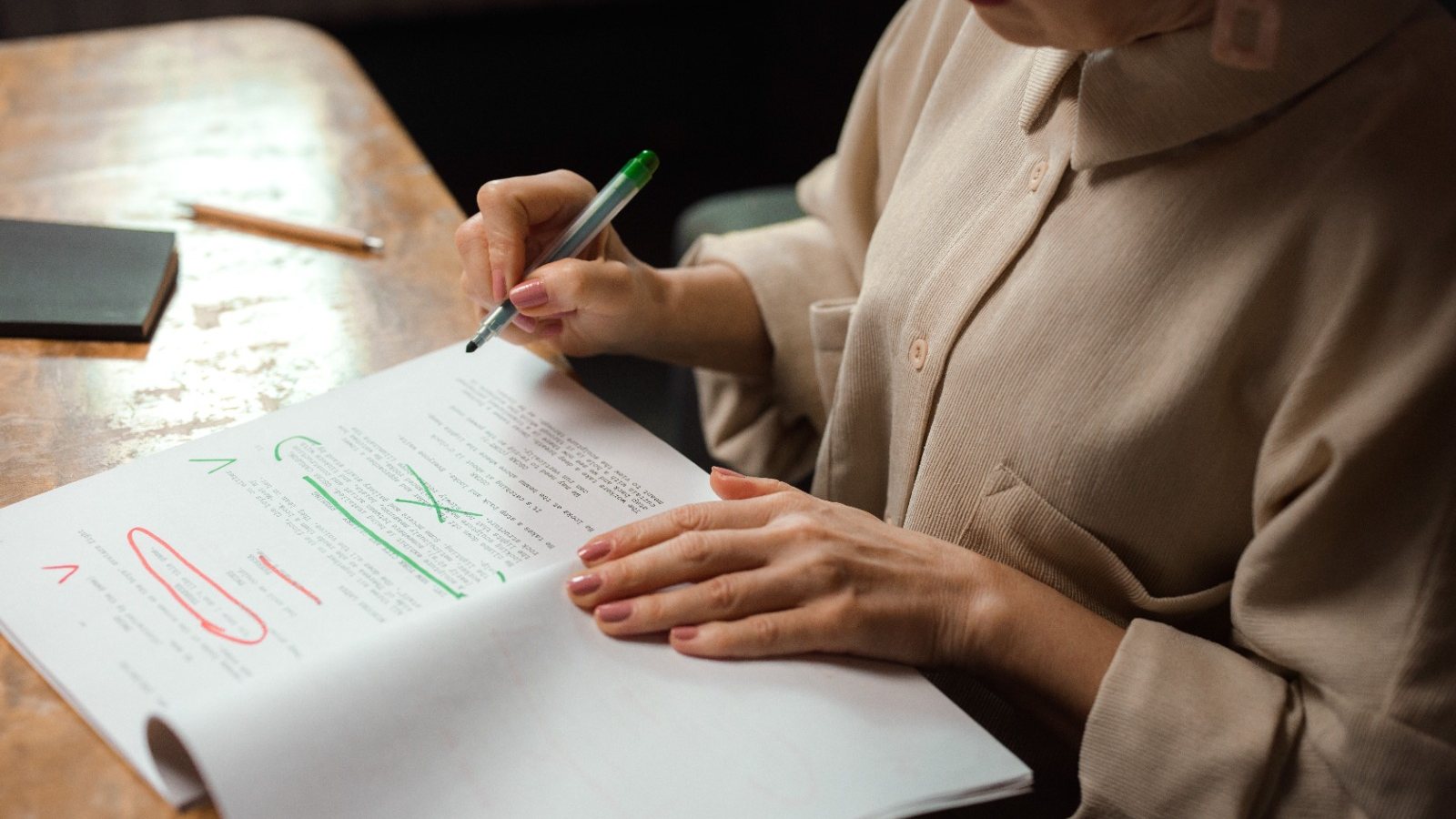
Saying "I need an editor" is a bit like saying "I need a doctor." True, probably. But a dermatologist won't do much for your knee.
Editing isn't one job. It's several, done by people who notice very different things. Some will tell you your story starts in the wrong place. Others will tell you there's a double space on page 212. Both are right, and both are annoying in their own special way.
So here's a friendly field guide to the main types of editing, roughly in the order your draft should meet them. To keep things fair, we'll hand each editor the same sentence:
The sentence
Suddenly, the the dragon, who was very big, suddenly flew away suddenly
Let's see what they do with it.
Stage 1 of 5The whole book
Developmental editing: the architect
The developmental editor looks at the whole building before anyone argues about paint colours. Does the story work? Does the argument hold up? Is chapter three doing anything, or just loitering around, taking up space?
This is the big-picture edit. Expect notes like "your villain vanishes for 80 pages" or "your real book starts on page 40." It's usually done on a complete draft, and it can mean serious rewriting.
Suddenly, the the dragon, who was very big, suddenly flew away suddenly
It's possible the whole plot just changed. Yikes.
You need this whenyou have a finished draft and a nagging feeling that something's off, but zero clue what it could be.
Stage 2 of 5The order of things
Structural editing: the furniture mover
This is where people get confused. Some editors fold structural editing into developmental editing; others offer it on its own. The simple difference: the developmental editor asks what your piece should be. The structural editor asks what order it should be in.
They move chapters, merge sections, trim repetition and smooth the path from one part to the next. Think of someone who keeps all your furniture but finally puts the sofa where the sofa belongs.
It's especially handy for non-fiction, reports and anything with a lot of moving parts.
Suddenly, the the dragon, who was very big, suddenly flew away suddenly
You need this whenthe content is good, but readers keep getting lost.
Stage 3 of 5The sentence
Line editing: the stylist
Now we zoom in. The line editor goes sentence by sentence, tuning rhythm, tone, word choice and clarity. Their job is to make your writing sound like you, on a very good day.
They'll cut your fourth "suddenly," untangle the sentence you wrote at 2 a.m., and gently ask whether every character really needs to "sigh" quite so often. I just did a book with so many "he smiled faintly"s that I wanted to shake the milquetoast character.
Suddenly, the the dragon, who was very big, suddenly flew away suddenly The dragon spread its wings and was gone.
You need this whenthe story is solid, but the writing feels clunky, flat, or a little too fond of adverbs.
Stage 4 of 5The rules
Copyediting: the rule keeper
The copyeditor is the friend who notices your shoelace is untied, and also that you've spelled your main character's name two different ways.
They check grammar, punctuation, spelling and consistency. Is it "email" or "e-mail"? Did the hero's eyes turn from green to brown in chapter nine? Is that a hyphen or an en dash? (Yes, there's a difference. No, they won't stop explaining it.)
Most work from a style guide, so your writing follows the same rules from the first page to the last.
Suddenly, the the dragon, who was very big, suddenly flew away suddenly
You need this whenthe writing is basically done and you want it clean and consistent.
Stage 5 of 5The full stop
Proofreading: the last line of defence
Proofreading is the final check before your work meets the world. It happens on the near-final version, often the formatted layout, and catches whatever slipped through: typos, missing words, stray spaces, wobbly page numbers.
It's the equivalent of checking your teeth for spinach before a date. Small thing. Big consequences if you skip it.
A proofreader won't rewrite your sentences or question your plot. That ship has sailed, and frankly, so has the dragon.
Suddenly, the the dragon, who was very big, suddenly flew away suddenly.
You need this whenyou're about to publish, print or hit send.
The cheat sheet
In short: start big, finish small.
| Type | Focuses on | Best time | The big question |
|---|---|---|---|
| Developmental | Ideas, story, argument | First full draft | Does this work? |
| Structural | Order and flow | Once the content is settled | Is this in the right order? |
| Line | Style, voice, clarity | Once the structure is set | Does this read well? |
| Copyediting | Grammar, consistency | Near-final text | Is this correct? |
| Proofreading | Typos, layout | Final version | Did anything slip through? |
Why the order matters
The golden rule: don't proofread a chapter you might delete. Polishing commas on page 50 is wasted effort if pages 40 to 60 are about to go. Work from the big picture down to the tiny details, and each round makes the next one easier.
You won't always need every type, either. A blog post might only need a copyedit. A novel might need the full tour.
Not sure which kind your draft needs? That's exactly what we're here for. At Aster House Books, we'll take an honest look and tell you whether it needs a full rethink or just a quick polish. We can be found (usually) at hello@asterhousebooks.com. Let's find your draft the editor it actually needs.
The dragon, meanwhile, is still deciding whether to fly away.